Product
CoBuy 3.0
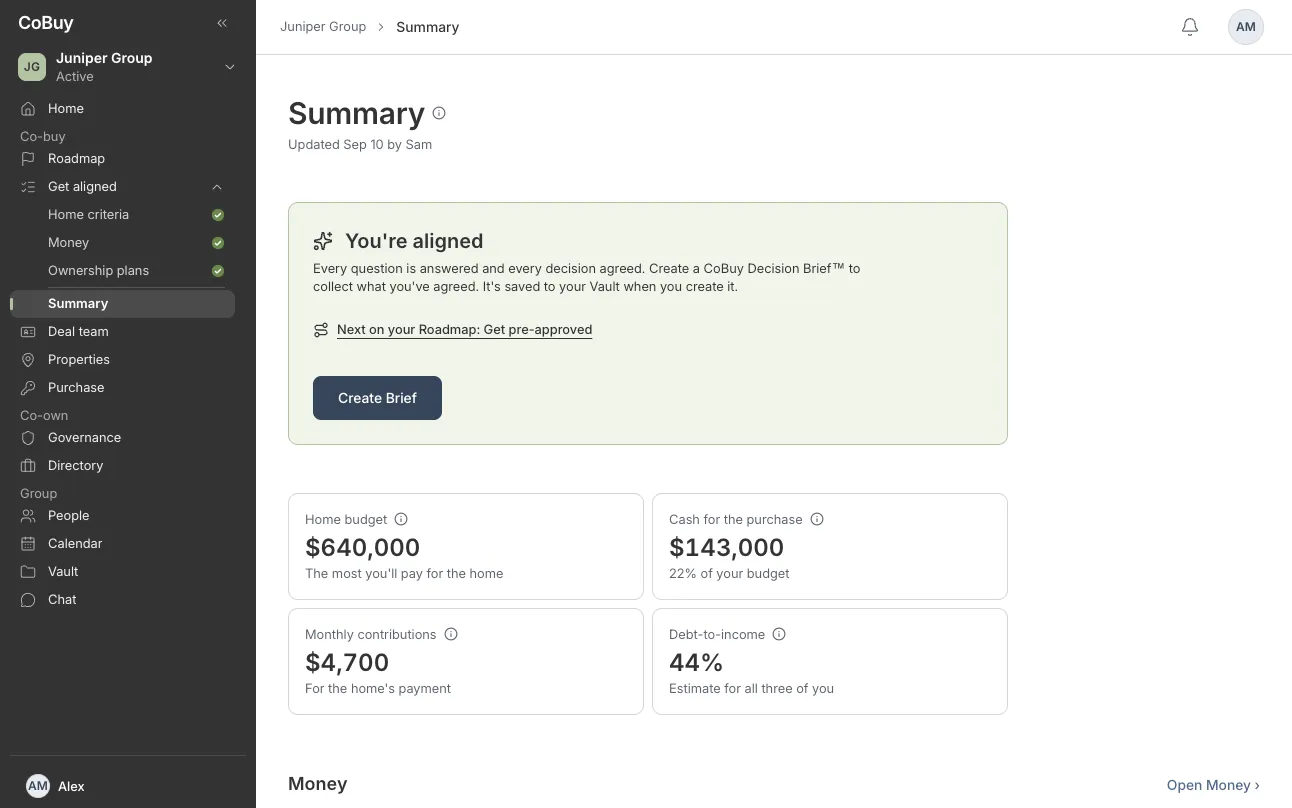
I’m building one workspace for a group’s plans, finances, decisions, professional handoffs and ownership records. Nobody starts over after the purchase.
ProofThree customer routes, built around one shared model of people, property and decisions.
My role
I lead the product and commercial model. I designed the ontology, information architecture and delivery controls, and direct the AI-assisted build.
Results
- Three routes on one foundation: groups buying together, groups that already own, and multigenerational home projects.
- A group that buys keeps its plans, records and decisions as it moves into ownership. Existing owners enter directly.
- Each release candidate is audited by a separate AI session that didn’t build it, and it can block release.
What it is
Co-ownerOS™ and CoBuy Wizard grew up as separate products. Customers don’t think that way. They plan, they buy, they own. So we’re building one workspace that carries a group the whole way.
It serves three kinds of group. Co-buyers, from forming the group through the purchase and into ownership. Co-owners who already have the home and come straight in. And families planning a multigenerational home through Compound, our service for one property with room for every generation.
Why it needed a new model
Co-ownership isn’t one user and one transaction. It’s several people, changing over time, around one or more homes. Software built for a single buyer breaks on that. So I started with the model, not the screens.
The model
The ontology defines what exists, how it relates and how it can change.
- A person isn’t a membership. One person can be in several groups, with a different role in each.
- A group isn’t a property. A group can weigh, reject, buy, own and sell more than one home, sometimes at once.
- A proposal isn’t a decision. What someone suggested, how each person answered and what the group agreed are kept apart. Nothing becomes “decided” because someone, or an AI, summarized it that way.
That’s what lets the product keep its state. A rejected house keeps its history. A new member doesn’t reset the group. An owner can start a second project without a second account.
How it’s organized
- Work that fits the situation. A group sees what’s relevant to where it is. Nobody is marched through a wizard.
- Who answered, and where people differ, in plain view. Disagreement is shown, not averaged away.
- Governance that keeps going. Agreements, obligations and decisions stay live after closing. It isn’t a one-time document generator.
Trust, by design
Who you are, what you’re allowed to do, what you’ve consented to and what you’ve paid for are four separate things, and the product treats them that way. Evidence is versioned. Consequential actions require the right approvals, tied to the version being acted on.
So what
One coherent product, not parallel ones. It keeps a group’s state from the first conversation on, and it can take on new kinds of customer and project without another silo.
It’s in active development, not yet released. The technical figures on this page are a snapshot of the build.
It’s also where I’ve pushed AI-built software hardest. Separate agents build, verify and audit. Nothing ships because the agent that wrote it says it’s fine.
Screens
More proof
- 2,393 tests behind 5 parallel release gates, as a build snapshot.
- A 149-component design system.
- 76 database tables, every one with row-level security. 91 policies and 160 database functions.
- Every change is a named, audited action.
- 201 database assertions, and a performance budget at phone width.
- Mapped across 32 capabilities and 96 governed data mappings.
Related work